America’s Biofuel Boom Has a Feedstock Problem, and Record Crush Isn't Enough. U.S. Vegetable-Oil Import Dependence Grows as Biofuel Demand Accelerates.

Record soybean and canola processing is expanding U.S. vegetable-oil supplies, but biofuel demand is expanding even faster. Demetrica estimates the U.S. net vegetable-oil import requirement could exceed 7 million metric tons in 2026/27, while combined vegetable-oil and used cooking oil imports could approach nearly 10 million metric tons.

Data sources: USDA GATS, USDA PSD, Demetrica estimates
For several years, the U.S. vegetable oil market has been moving through a structural transformation. Renewable diesel and biodiesel expansion increased competition for soybean oil, canola oil, used cooking oil (UCO), animal fats, and other feedstocks. Soybean and canola crush expanded. Imports of vegetable oils expanded. Soybean oil exports collapsed. None of this is particularly new anymore. What is becoming increasingly important, however, is the scale of the adjustment, and the fact that record domestic oilseed processing has not eliminated the need for imported oils and feedstocks.
The latest U.S. trade data through July 2026 reinforce that trend. UCO imports have accelerated again after slowing earlier in the marketing year (October-September). Soybean oil imports have surged during recent months, and palm oil imports have also accelerated. Canola oil imports remain close to 3 million metric tons. Individually, each trade flow has its own explanation, but taken together, however, they point toward the same conclusion: the United States is producing more vegetable oil than ever, but its demand for fats and oils is growing even faster. And with considerably higher biofuel requirements now in place for 2026 and 2027, that imbalance could become even more pronounced.
Renewable fuels changed the U.S. vegetable oil trade balance
The transformation did not happen overnight. Before the recent expansion of renewable diesel, U.S. vegetable oil imports were relatively stable. In 2017/18, the United States imported approximately 4.8 million metric tons of vegetable oils and exported about 1.3 million tons. The resulting net import position was approximately 3.4 million tons. By 2022/23, vegetable oil imports had climbed to approximately 6.3 million tons, while exports collapsed to about 335,000 tons. The change was particularly dramatic for soybean oil, as rapid growth in renewable diesel increased domestic demand for soybean oil, pushed U.S. soybean oil prices above those of competing South American supplies, and contributed to an approximately 80-percent decline in exports. The United States subsequently became a net soybean oil importer on a volume basis in 2023. At the same time, the market began pulling in substantially more canola oil and alternative feedstocks.
U.S. canola oil imports accelerated after the EPA approved canola-oil pathways under the Renewable Fuel Standard in late 2022. Then UCO arrived in extraordinary quantities. The result is visible in the longer-term trade data. What was once largely a story about imported palm and canola oil has become a much broader story about how the United States sources the fats and oils necessary to supply both its food system and an increasingly feedstock-intensive biofuel sector.
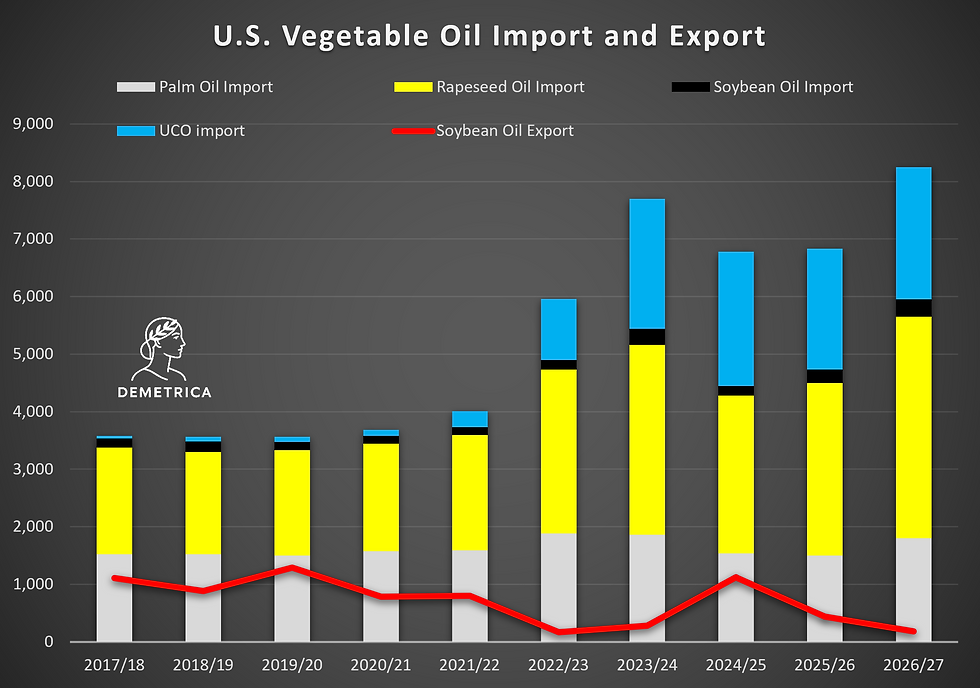
Data sources: USDA GATS, USDA PSD, Demetrica estimates (chart does not include minor oils such as coconut, palm kernel, olive, peanut, or cottonseed oil).
UCO slowed down, but it did not go away
Few feedstock markets illustrate the speed of this transformation better than used cooking oil. U.S. UCO imports were only about 100,000 metric tons in 2020/21, increased to 280,000 metric tons the following year, and then jumped to above 1 million metric tons in 2022/23. By 2023/24, imports reached nearly 2.3 million tons. That was the extraordinary phase of the UCO story. Supply, prices, renewable-fuel economics, and trade policy aligned, and the United States became a massive destination for internationally traded waste oils. However, the market changed again in 2025/26. UCO imports slowed, particularly as the policy environment surrounding foreign feedstocks changed, and Chinese shipments declined. But the latest trade data suggest it would be premature to conclude that U.S. demand for imported UCO is disappearing. Quite the opposite.
Through July, 2025/26, U.S. UCO imports reached approximately 1.5 million metric tons. More importantly, monthly shipments accelerated sharply during the summer. July imports approached 340,000 tons, one of the strongest months in the series. Based on that late-season acceleration, Demetrica has increased its 2025/26 UCO import estimate by 100,000 tons to approximately 2.1 million metric tons. That would still leave imports below the roughly 2.3 million tons recorded in 2024/25, but the decline is much smaller than might have been anticipated when Chinese trade began slowing.
And the dollar side tells another important story. Demetrica estimates the United States will spend approximately $2.5 billion on UCO imports in 2025/26, almost unchanged from the previous marketing year, despite lower import volumes. Based on the October–July trade data, average UCO import unit values are approximately 13 percent higher year over year. In other words, the United States may be importing less UCO, but it is paying substantially more for every ton it brings in.
The late-season rebound in total UCO imports suggests that the underlying U.S. appetite for waste-based feedstocks remains strong even as the origins change. USDA itself expects that dynamic to continue. In its May 2026 Oil Crops Outlook, ERS projected that imports of animal fats and UCO would increase in 2026/27 to help satisfy higher mandate-driven demand, particularly given the concentration of renewable diesel capacity along the U.S. coasts and continued incentives from state-level programs. That supports Demetrica's expectation that UCO imports could recover toward approximately 2.3 million metric tons in 2026/27.
Soybean oil imports accelerating
UCO is not the only import stream showing renewed momentum. Perhaps more surprising is what is happening with soybean oil. Through July, U.S. soybean oil imports for 2025/26 reached approximately 170,000 metric tons, already exceeding the roughly 164,000 tons imported during the entire 2024/25 marketing year. The monthly pattern is particularly notable. Imports averaged considerably lower levels during the first half of the marketing year before accelerating to approximately 33,000 tons in June and another 33,000 tons in July. If August and September remain close to those recent levels, Demetrica estimates 2025/26 soybean oil imports could approach 230,000 metric tons.
That would be roughly 50,000 tons above USDA's August projection.
On its own, 50,000 tons is not a large number in the U.S. soybean complex, but it becomes more interesting when considered alongside another development: soybean oil exports have recovered. Demetrica currently expects 2025/26 soybean oil exports of approximately 440,000 metric tons, substantially above the extremely depressed levels seen during the initial renewable diesel expansion. That creates an increasingly interesting balance-sheet question. The United States is crushing enormous quantities of soybeans, yet it is simultaneously exporting more soybean oil, importing more soybean oil, and directing very large quantities of domestically produced oil toward biofuel production. Something has to balance those flows.
What to watch in the upcoming WASDE
The recent trade data suggest several areas where USDA's U.S. vegetable oil balance sheets may eventually require adjustment. The most immediate is soybean oil. If imports remain strong through August and September, USDA's current import projection could prove approximately 50,000 metric tons too low. With exports also running strongly, the additional disappearance would have to be reconciled elsewhere in the balance sheet.
Additional soybean crush is one possibility, although U.S. crush is already at historically high levels. Another place to watch is the use of soybean oil in food. If more domestically produced soybean oil is directed toward biofuels while exports remain strong, some food demand may shift toward competing oils. That does not mean every additional ton of imported palm oil directly replaces a ton of soybean oil, but the recent palm oil trade pattern makes this relationship increasingly worth watching.
U.S. palm oil imports accelerated considerably during the spring and summer. Imports rose to approximately 146,000 metric tons in May, 143,000 metric tons in June, and 159,000 metric tons in July, after several months below 100,000 metric tons. Demetrica currently estimates palm oil imports at approximately 1.5 million metric tons for 2025/26, with imports potentially increasing to 1.8 million metric tons in 2026/27. This is one of the less discussed consequences of the U.S. biofuel transformation: when more domestically produced food oils are burned as fuel, the adjustment can show up elsewhere in the food-oil complex. In the United States, palm oil is heavily used in manufactured and highly processed foods. Increasing biofuel demand for soybean and canola oil, therefore, does not necessarily eliminate vegetable oil consumption elsewhere; it can alter which oil ultimately reaches the food market.
Canola oil could move the other way
Canola—or rapeseed—oil presents a somewhat different near-term picture. October–July 2025/26 imports reached approximately 2.4 million metric tons. Recent monthly shipments have been slightly below the pace required to reach USDA's current projection of approximately 3.05 million tons. Demetrica therefore expects full-year imports closer to 3.0 million metric tons. There may be room for a modest downward USDA adjustment, potentially around 100,000 tons, but that would not materially change the larger story. Three million metric tons of annual canola oil imports remain an enormous trade flow.
And the outlook becomes considerably stronger again in 2026/27.
Record soybean crush is not eliminating import dependence
This is perhaps the most important conclusion from the latest data. The United States is not importing more oil because domestic oilseed processing is stagnant. It is doing so even as domestic processing expands.
EPA's final Set 2 rule establishes biomass-based diesel requirements of 8.86 billion RINs in 2026 and 8.95 billion in 2027. Including reallocation associated with small refinery exemptions, applicable volumes reach 9.07 billion RINs in 2026 and 9.20 billion in 2027. EPA estimates that biodiesel and renewable diesel production and use will need to increase by more than 60 percent compared with 2025 levels to satisfy the new requirements.
That creates the central tension in the U.S. oils market. The United States can crush more soybeans, it can crush more canola, it can increase domestic UCO collection and rendering, but the biofuel sector is simultaneously asking for substantially more feedstock.
The latest trade numbers suggest domestic supply growth alone is not closing that gap.
The U.S. net vegetable oil import requirement remains above 5.5 MMT
Demetrica's revised 2025/26 balance provides a useful way of seeing the scale of this structural change. We currently estimate U.S. conventional vegetable oil imports at approximately 6.2 million metric tons in 2025/26, while exports are expected to be only about 600,000 tons. That leaves a net vegetable oil import requirement of approximately 5.6 million metric tons. We deliberately use the term "net import requirement" rather than "deficit". The United States is not facing a literal shortage of 5.6 million tons. Rather, this number measures how much larger vegetable oil imports are than exports as the domestic market balances production, food use, industrial use, and biofuel demand.
UCO adds another dimension. Including our 2.1-million-ton UCO estimate, gross U.S. vegetable oil and UCO imports total approximately 8.3 million metric tons in 2025/26.
For perspective, the comparable combined figure was only about 4.8 million tons in 2017/18. The composition has changed dramatically along the way, but the direction is unmistakable. The United States has become a much larger importer of the fats and oils required to balance its domestic market.
2026/27 could push the import requirement to a record
And this is where the outlook becomes considerably more consequential. With Demetrica's slightly higher assumptions for palm and soybean oil imports, conventional U.S. vegetable oil imports could rise to approximately 7.5 million metric tons. At the same time, vegetable oil exports could decline to only 320,000 tons. That would push the net U.S. vegetable oil import requirement to approximately 7.2 million metric tons, a record in our series. Combined conventional vegetable oil and UCO imports could approach 9.7 million metric tons in 2026/27. That is nearly 10 million tons of imported oils and waste-oil feedstock entering the United States in a single marketing year. It would also be more than double the approximately 4.8 million tons of combined vegetable oil and UCO imports recorded in 2017/18.
More American biofuel does not necessarily mean less imported feedstock
There is an apparent contradiction at the center of U.S. biofuel policy. The United States is pursuing higher domestic renewable fuel production partly to strengthen its energy and agricultural markets. EPA's final 2026–27 standards explicitly emphasize the use of homegrown feedstocks and increased demand for U.S. agricultural commodities. And that demand is real. U.S. soybean crush is expanding substantially. Canola processing is expanding. Soybean oil consumption for fuel is projected to rise sharply, but the fats-and-oils market does not operate in isolation. Every additional ton of domestic soybean oil directed toward renewable diesel is a ton that cannot simultaneously be consumed in food, exported, or carried into stocks. If domestic oil production cannot expand quickly enough to satisfy all of those competing uses, the market responds through prices, substitution and trade. That is exactly what we are seeing. First came the collapse in soybean oil exports. Then came record canola oil imports. Then came the extraordinary UCO import boom. Now soybean oil imports are accelerating again, UCO purchases have strengthened late in the marketing year, and palm oil imports are worth watching as domestic food markets adjust. The United States is importing more vegetable oils and animal fats both directly as biofuel feedstocks and indirectly to replace oils diverted from other uses. The latest data suggest that process is not ending. It is intensifying.
The next phase of the U.S. biofuel story is about feedstock availability
For the oilseed market, the question is therefore no longer simply whether the United States can crush enough soybeans. The more important question is whether domestic production of all eligible fats and oils can expand fast enough to keep pace with biofuel demand without requiring progressively larger adjustments elsewhere in the market.
For 2025/26, the answer appears to be no. Despite record processing, the United States is still running a net vegetable oil import requirement of roughly 5.6 million metric tons, while importing another 2.1 million tons of UCO. And 2026/27 looks even more demanding.
If current policy and projections hold, Demetrica expects the U.S. net vegetable oil import requirement could approach 7 million metric tons, while combined vegetable oil and UCO imports could approach 10 million tons. That does not mean the United States lacks oilseeds. It means biofuel demand is expanding faster than the domestic fats-and-oils system can currently expand with it. Record crush and record imports are therefore not contradictory. They are increasingly two sides of the same U.S. biofuel story.


Comments